
Understanding Why Thousands of Global Businesses Choose the UAE as Their International Trade Hub
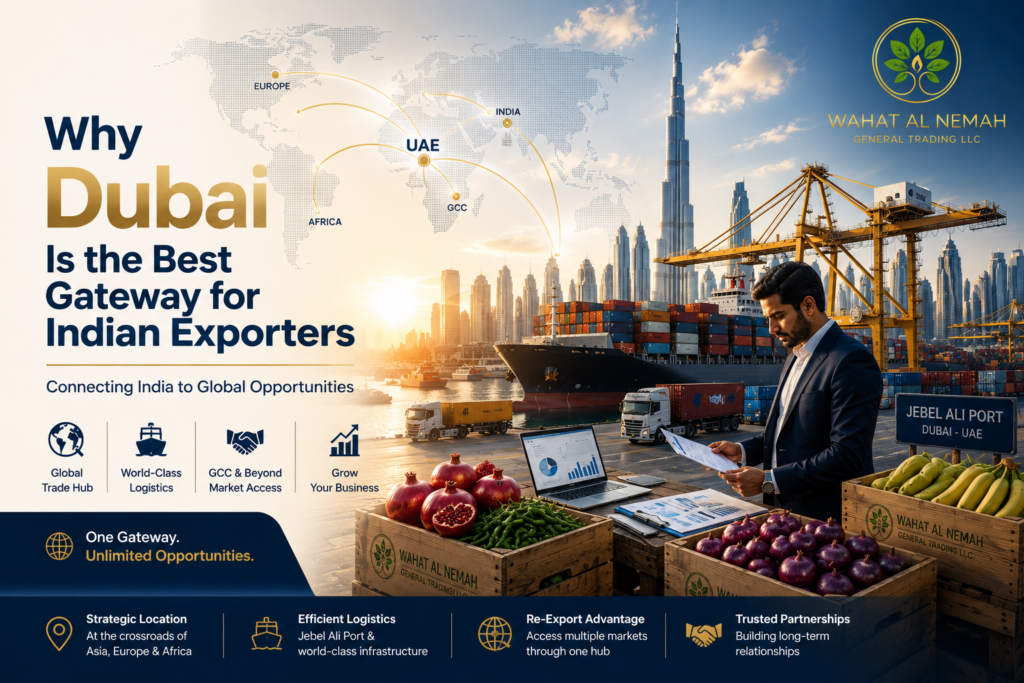
International trade is no longer driven by manufacturing capacity alone.
Today, successful exporters compete on speed, reliability, market access, logistics efficiency, and their ability to serve multiple countries through one strategic location.
For Indian exporters looking to expand internationally, few markets offer the commercial advantages that Dubai does.
While many businesses initially see Dubai as an export destination, experienced exporters understand that it plays a much larger role in global commerce.
Dubai is not simply a market.
It is one of the world’s most established international trading hubs—a place where products arrive from across the globe before being distributed to buyers throughout the GCC, Africa, CIS countries, and other international markets.
For businesses planning long-term international growth, understanding why Dubai occupies this position is essential.
Dubai Is Built for International Trade
Some cities became trading centres because of geography.
Dubai became a global trading hub because it invested heavily in creating an ecosystem that supports international business.
Over the past few decades, the UAE has developed:
- World-class seaports
- Modern international airports
- Extensive free zone infrastructure
- Advanced logistics parks
- Cold chain facilities
- Efficient customs procedures
- Strong banking systems
- International business regulations
This integrated infrastructure allows cargo to move efficiently while reducing unnecessary delays throughout the supply chain.
For exporters, operational efficiency often translates directly into commercial success.
A Gateway to Multiple Markets—Not Just One
One of the biggest advantages of exporting through Dubai is that businesses are not limited to serving only the UAE market.
Dubai acts as a regional redistribution hub.
Products imported into the UAE are frequently re-exported to neighbouring countries based on market demand.
This provides access to markets such as:
- Saudi Arabia
- Oman
- Kuwait
- Bahrain
- Qatar
- Iraq
- East Africa
- CIS countries
Instead of establishing separate operations in multiple countries, many exporters build their regional business through Dubai.
This approach simplifies logistics while expanding market reach.
Why Re-Export Matters
Many first-time exporters underestimate the importance of re-export.
In practice, it is one of Dubai’s greatest commercial strengths.
A shipment arriving at Jebel Ali Port may not remain in the UAE.
Depending on buyer requirements, inventory can later be redistributed across multiple regional markets.
This flexibility enables businesses to:
- Respond to changing demand
- Enter new markets with lower risk
- Reduce dependence on a single country
- Expand their customer base gradually
- Improve inventory movement
For exporters seeking long-term growth, diversification is often more valuable than relying on one profitable market.
Jebel Ali Port: One of the World’s Leading Trade Gateways
International trade depends heavily on logistics.
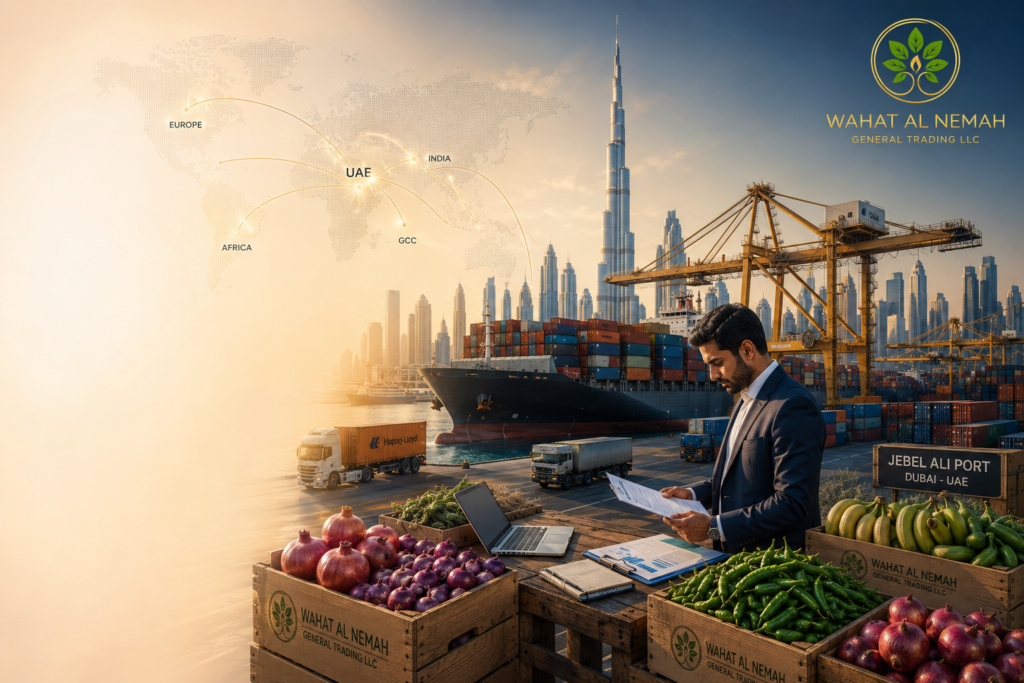
Among Dubai’s greatest strengths is Jebel Ali Port, one of the busiest container ports in the world.
Its connectivity provides exporters with:
- Extensive global shipping routes
- High container handling capacity
- Efficient cargo processing
- Strong feeder connections across the GCC
- Reliable access to regional markets
For businesses exporting agricultural products, FMCG goods, industrial materials, and consumer products, efficient port operations help reduce delays and maintain supply chain reliability.
Fresh Produce Requires More Than Good Farming
For exporters dealing in fresh fruits and vegetables, product quality begins at the farm—but international success depends on everything that happens afterward.
Fresh produce exports require coordination across multiple stages, including:
- Harvest planning
- Pre-cooling
- Grading
- Packaging
- Cold storage
- Reefer container loading
- Customs clearance
- Shipping schedules
- Destination handling
Even a short delay in any of these stages can reduce shelf life and affect market value.
This is why logistics is not simply a transportation function—it is part of the product itself.
Buyers in the GCC Purchase Consistency, Not Just Products
Many exporters believe competitive pricing is the key to winning international business.
In reality, experienced buyers evaluate suppliers differently.
Professional importers look for partners who consistently deliver:
- Uniform product quality
- Reliable shipment schedules
- Accurate documentation
- Fast communication
- Operational transparency
- Long-term commitment
A supplier who delivers consistently often earns repeat business, even when competitors occasionally offer lower prices.
Trust is built through execution, not promises.
Documentation Protects Every Shipment
One of the most overlooked aspects of international trade is documentation.
A container may leave the origin on time, yet still face delays if documentation is incomplete or inaccurate.
Professional exporters pay close attention to:
- Commercial Invoice
- Packing List
- Bill of Lading
- Certificate of Origin
- Phytosanitary Certificate
- Health Certificates
- HS Code Classification
- Import Compliance Requirements
Strong documentation discipline protects both the shipment and the commercial relationship.
Why Relationships Matter in Dubai
International trade is built on people before it is built on products.
Dubai’s business community values long-term relationships, consistency, and professionalism.
Buyers remember suppliers who:
- Maintain quality during difficult seasons
- Communicate honestly when challenges arise
- Resolve issues promptly
- Deliver on commitments
Likewise, they remember exporters who fail to meet expectations.
In competitive markets, reputation often travels faster than cargo.
Diversification Is a Competitive Advantage
Market conditions change constantly.
Freight rates fluctuate.
Consumer demand shifts.
Weather affects agricultural production.
Currency values move.
Businesses that depend heavily on a single market often face greater commercial risk.
Dubai enables exporters to diversify their customer base across multiple countries, reducing dependence on any one destination.
This flexibility supports more stable long-term growth.
Success in Dubai Requires More Than Shipping Products
Exporting successfully to Dubai involves more than arranging transportation.
It requires understanding:
- Buyer expectations
- Market timing
- Regional pricing
- Distribution networks
- Product positioning
- Compliance requirements
- Supply chain coordination
Businesses that invest in these areas are generally better positioned to build sustainable international operations.
Final Thought
Dubai has established itself as one of the world’s most important trading centres because it combines strategic location, world-class infrastructure, efficient logistics, and access to multiple international markets.
For Indian exporters, it offers more than a destination for products.
It provides a platform for regional expansion, stronger commercial partnerships, and long-term international growth.
As global trade becomes increasingly competitive, businesses that focus on quality, operational discipline, and trusted relationships will be best positioned to succeed.
Dubai is not simply a place to export.
It is a place to build an international business.
About Wahat Al Nemah General Trading LLC
Wahat Al Nemah General Trading LLC is a Dubai-based international trading company specializing in fresh produce, agro commodities, sourcing, commission sales, consignment trade, GCC market access, and regional re-export solutions.
Working closely with exporters, growers, wholesalers, distributors, and logistics partners, the company helps businesses connect with opportunities across the UAE, GCC, Middle East, Africa, and other international markets. With a strong focus on transparency, operational excellence, and long-term partnerships, Wahat Al Nemah supports sustainable international trade built on trust, reliability, and consistent execution.