
Challenges In Perishables Trade
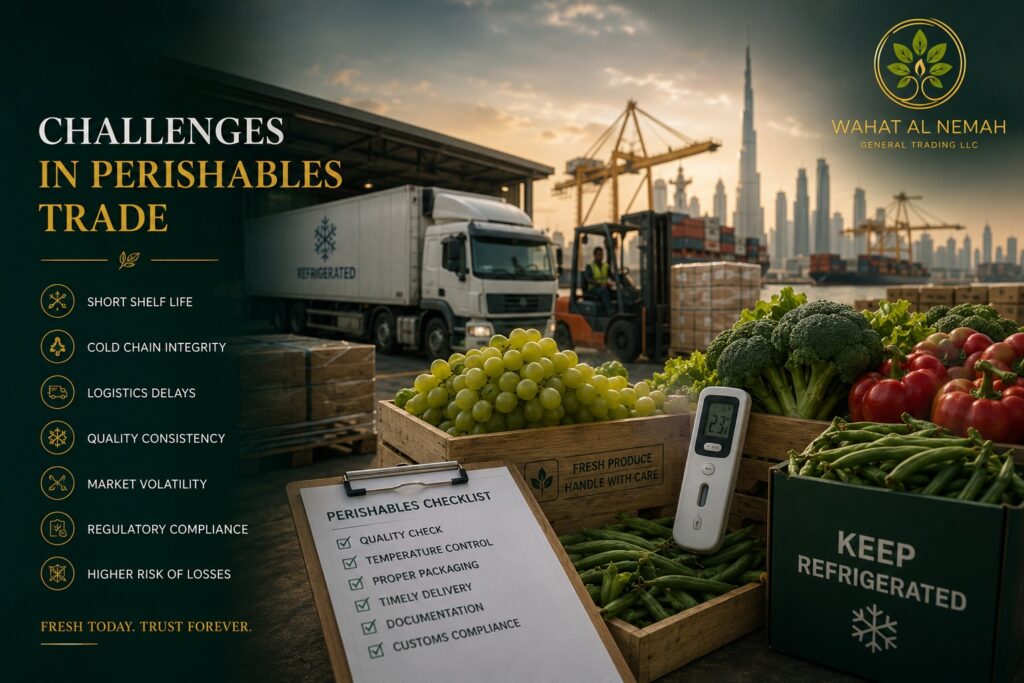
What Fresh Produce Exporters Learn Only After Containers Start Moving
Perishables trade looks simple from a distance.
A farmer harvests.
A supplier packs.
A container loads.
The shipment sails.
The buyer receives cargo.
But anyone who has spent time inside the fresh produce business knows the reality is far more demanding.
Perishables trade is one of the most operationally sensitive sectors in international commerce.
Margins can disappear overnight.
Weather changes can alter quality within days.
Logistics delays can damage an entire shipment.
One weak link in the cold chain can affect months of relationship-building.
And unlike many other industries, perishables do not wait for systems to improve.
Fresh produce moves on biological time.
Fresh Produce Does Not Forgive Operational Mistakes
One of the biggest misconceptions in perishables trade is believing the business is driven only by sourcing and pricing.
In reality, perishables exports are driven by execution.
A shipment may begin with excellent farm quality and still fail because of:
- delayed loading
- poor pre-cooling
- weak packaging
- inconsistent grading
- reefer malfunction
- customs delays
- temperature fluctuations
- poor destination handling
- weak market timing
By the time problems become visible, the cargo is already moving internationally.
And in perishables trade, recovery options are often limited.
The Pressure Of Time
Unlike dry cargo, perishables operate under constant time pressure.
Every hour matters.
A delay at:
- farm collection
- packhouse operations
- container stuffing
- customs clearance
- port handling
- vessel connection
- destination clearance
can directly affect shelf life and market value.
Exporters working in:
- onions
- bananas
- grapes
- pomegranates
- green chillies
- coconuts
- vegetables
- leafy produce
understand this reality very well.
A shipment may technically arrive “on time” and still lose market value because of reduced freshness window.
This is why experienced perishables traders focus obsessively on logistics coordination.
Cold Chain Discipline Is Everything
In perishables exports, temperature is not just a technical parameter.
It is a commercial factor.
Cold chain discipline influences:
- shelf life
- buyer confidence
- market pricing
- repeat business
- claim risk
- destination handling quality
Even small inconsistencies can create major consequences later.
Professional exporters monitor:
- pre-cooling
- reefer settings
- humidity control
- ventilation parameters
- transit duration
- port congestion risks
- unloading coordination
throughout the shipment cycle.
Because once fresh produce deteriorates, negotiation power weakens immediately.
Market Volatility Is Constant
Perishables markets move fast.
A market that is highly profitable one week can become oversupplied the next.
Prices fluctuate due to:
- arrivals volume
- weather
- local production
- religious seasons
- consumer demand
- shipping disruptions
- geopolitical developments
- freight changes
This is especially visible in GCC wholesale markets where daily arrivals influence pricing rapidly.
Exporters who survive long term learn not to become emotionally attached to temporary price spikes.
Consistency matters more than short-term excitement.
Quality Expectations Have Changed
Global buyers today expect more than just product availability.
They expect:
- consistency
- traceability
- food safety discipline
- proper packaging
- shelf-life management
- visual presentation
- professional communication
- operational transparency
And in competitive markets like Dubai, Saudi Arabia, Qatar, Oman, and Kuwait, buyers often compare suppliers across multiple countries simultaneously.
This means exporters must continuously improve:
- packhouse systems
- grading discipline
- sourcing quality
- packaging standards
- communication speed
- shipment reliability
The market rewards exporters who think long term.
Documentation Is Often Underrated
Many new exporters focus heavily on product movement but underestimate documentation.
In perishables trade, documentation errors can create:
- customs delays
- demurrage
- rejection risks
- destination penalties
- clearance complications
Accuracy matters in:
- phytosanitary documentation
- packing lists
- COO
- invoices
- labeling
- HS classification
- health certifications
- destination compliance
Strong documentation discipline is not paperwork.
It is shipment protection.
GCC Markets Demand Relationship Discipline
The GCC remains one of the world’s most dynamic perishables ecosystems.
Dubai in particular functions as:
- an import hub
- a redistribution center
- a re-export gateway
- a wholesale trade ecosystem
- a pricing reference market for regional trade
But GCC markets also operate heavily on:
- relationships
- consistency
- reliability
- reputation
- execution speed
Buyers remember:
- delayed shipments
- inconsistent quality
- poor communication
- broken commitments
And they also remember exporters who stay dependable during difficult situations.
Long-term business in perishables is rarely built through one shipment.
It is built through reliability over time.
Freight & Logistics Remain One Of The Biggest Challenges
Over the past few years, perishables exporters globally have faced:
- container shortages
- vessel rollovers
- freight volatility
- transit delays
- congestion risks
- rising cold chain costs
And because fresh produce is time-sensitive, perishables traders often absorb higher operational pressure than many other industries.
Good logistics partners therefore become extremely valuable.
Strong freight coordination is no longer optional.
It is a competitive advantage.
Real Trade Happens Beyond Social Media
One thing the perishables industry teaches very quickly:
The real work happens behind the scenes.
Not in polished photographs.
Not in container selfies.
Not in volume announcements.
Real work happens in:
- farms
- warehouses
- packhouses
- cold rooms
- loading points
- wholesale markets
- late-night shipment calls
- temperature checks
- quality inspections
- buyer negotiations
Perishables trade rewards patience, observation, systems, and operational discipline.
And often, the most experienced exporters speak the least.
Because they understand how difficult consistency truly is.
Final Thought
Perishables trade remains one of the most demanding yet rewarding sectors in international business.
It connects farmers, exporters, logistics operators, wholesalers, retailers, and consumers across countries every single day.
But success in perishables is rarely built on price alone.
It is built on:
- trust
- timing
- quality discipline
- logistics execution
- relationship management
- operational consistency
The exporters who survive long term are usually not chasing shortcuts.
They are quietly improving systems shipment after shipment.
Because in perishables trade, reputation travels faster than cargo.
About Wahat Al Nemah General Trading LLC
Wahat Al Nemah General Trading LLC is a Dubai-based international trading company focused on fresh produce, agro commodities, sourcing, GCC trade operations, and regional re-export ecosystems across the Middle East and Africa. The company works closely with growers, exporters, logistics operators, and buyers with a strong focus on quality discipline, operational reliability, and long-term trade relationships.
Contact :+971 557850489