
BL , DO & Payment Risks In International Trade
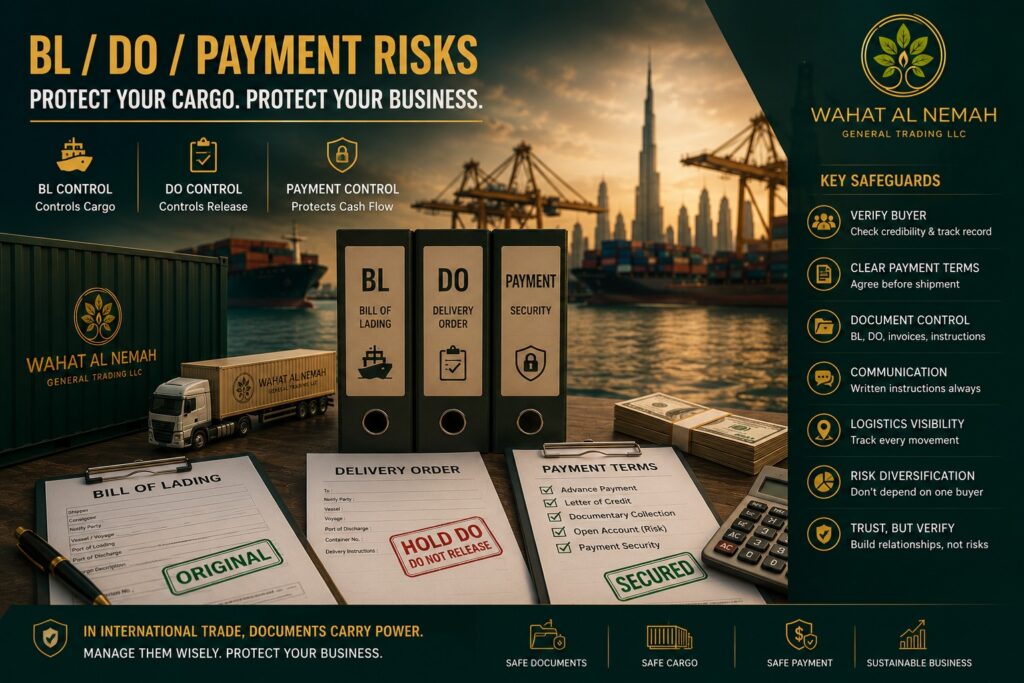
What Exporters Must Understand Before Cargo Leaves The Port
One of the biggest misconceptions in exports is believing that risk ends once the shipment is dispatched.
In reality, some of the most serious problems in international trade begin after the container has already sailed.
Especially in markets involving perishables, fast-moving cargo, re-export hubs, and relationship-based trade ecosystems, the handling of:
- Bill of Lading (BL)
- Delivery Order (DO)
- payment structures
- document control
- cargo release authority
can decide whether an exporter gets paid — or faces a major loss.
And many exporters only understand the importance of these systems after experiencing operational or financial damage firsthand.
The Dangerous Gap Between Shipment & Payment
In domestic trade, sellers often maintain physical visibility over goods.
International trade is different.
Once cargo moves:
- jurisdictions change
- shipping lines become involved
- destination agents enter the process
- local regulations apply
- logistics intermediaries increase
- enforcement becomes slower
At that stage, documentation becomes power.
And whoever controls cargo release effectively controls leverage.
This is why experienced exporters focus heavily on document discipline long before shipment arrival.
Understanding The Bill Of Lading (BL)
The Bill of Lading is not just a shipping document.
It is one of the most important control instruments in international trade.
A BL generally serves as:
- proof of shipment
- evidence of cargo receipt
- transport contract reference
- document linked to cargo ownership/control
Depending on shipment structure, release terms, and shipping arrangements, control over the BL can significantly influence who gains access to cargo.
This is why exporters must fully understand:
- Original BL
- Seaway BL
- Telex release
- surrender procedures
- consignee structures
- notify party implications
before moving shipments internationally.
Many new exporters unfortunately focus only on dispatch speed and overlook documentation consequences.
The Risk Around Delivery Orders (DO)
A Delivery Order is often where practical cargo control shifts operationally at destination.
Once a DO is released and destination processes move forward, exporters may lose significant leverage — especially if payment disputes already exist.
In difficult situations, exporters sometimes assume:
“If I instruct cargo hold, the shipment is safe.”
But international trade realities are not always that simple.
Because cargo movement can involve:
- shipping lines
- destination agents
- local clearance systems
- port operators
- customs structures
- intermediaries
- local legal practices
And by the time disputes escalate, the cargo may already be operationally beyond practical recovery.
This is why prevention matters far more than reaction.
Payment Risk Is Often Underestimated
One of the most dangerous habits in exports is increasing exposure too quickly after initial smooth transactions.
Many exporters experience:
- one successful shipment
- two timely payments
- positive buyer communication
And immediately begin extending larger credit terms.
But experienced traders understand:
Early success does not automatically guarantee long-term payment reliability.
Global markets can change quickly due to:
- liquidity pressure
- market crashes
- buyer overtrading
- operational losses
- intentional fraud
- geopolitical issues
- currency pressure
This is why payment discipline matters at every scale.
“Verified” Does Not Always Mean Safe
Modern trade has become heavily digitised.
Exporters today receive inquiries through:
- B2B platforms
- trade portals
- online directories
- sourcing marketplaces
And while these systems create opportunities, they can also create false comfort.
A polished company profile does not replace:
- market verification
- financial verification
- operational verification
- trade reference checks
Professional exporters quietly cross-check:
- imports history
- warehouse existence
- banking behaviour
- market references
- supplier relationships
- trade reputation
before scaling volumes aggressively.
Why GCC & Re-Export Markets Require Extra Discipline
Trade hubs like Dubai operate at remarkable speed.
That is one of their biggest strengths.
Cargo moves quickly.
Markets react quickly.
Re-export activity moves quickly.
But speed also means exporters must maintain stronger operational discipline.
Especially in perishables and agro commodities, once cargo reaches destination:
- storage costs begin
- quality pressure increases
- buyer negotiation power changes
- market volatility affects pricing
This creates pressure situations where exporters may feel forced into compromised decisions.
Experienced GCC traders therefore focus heavily on:
- documentation clarity
- payment structuring
- destination coordination
- relationship verification
- controlled exposure
before shipment movement.
Common Mistakes Exporters Make
Over time, several recurring mistakes appear repeatedly across trade disputes:
Scaling Too Fast
Large orders create excitement.
But unmanaged growth increases risk exposure rapidly.
Weak Documentation
Verbal discussions without written confirmation create future vulnerability.
Overdependence On One Buyer
Concentration risk becomes dangerous when payment cycles weaken.
Ignoring Early Red Flags
Delayed communication, changing payment behaviour, inconsistent instructions, and excessive urgency often signal deeper problems.
Weak Logistics Visibility
Exporters sometimes remain disconnected after shipment departure instead of monitoring every stage operationally.
Real Protection Comes From Systems
No international trade structure is completely risk-free.
Even highly experienced traders face:
- payment delays
- disputes
- claims
- market losses
- operational complications
But disciplined systems reduce exposure significantly.
Experienced exporters build protection through:
- controlled credit exposure
- staged trust-building
- documented communication
- legal clarity
- logistics visibility
- diversified buyer networks
- strong CHA/freight relationships
- operational patience
International trade rewards exporters who think long term.
Fear Should Not Stop Trade
Stories around payment defaults or cargo disputes often create fear among new exporters.
But fear is not the lesson.
The real lesson is preparation.
Global trade remains one of the most powerful opportunities for businesses willing to learn markets properly.
And the exporters who survive long term are usually not the most aggressive.
They are the most disciplined.
They verify carefully.
They document clearly.
They protect relationships.
And they understand that in exports, risk management is part of the business — not separate from it.
Final Thought
In international trade, containers do not move only with products.
They move with:
- trust
- documentation
- financial exposure
- reputation
- operational discipline
And once cargo starts moving globally, small mistakes can become expensive very quickly.
This is why experienced exporters constantly repeat one simple principle:
Verify first.
Structure carefully.
Move professionally.
Because in exports, prevention is always cheaper than recovery.
About Wahat Al Nemah General Trading LLC
Wahat Al Nemah General Trading LLC is a Dubai-based international trading company focused on fresh produce, agro commodities, sourcing, GCC trade operations, and regional re-export ecosystems across the Middle East and Africa. The company works closely with exporters, importers, logistics operators, and wholesale trade networks with a strong focus on operational discipline, reliable trade execution, and long-term business relationships.
Phone:+971 557850489
Email:Info@wahatalnemah.com